
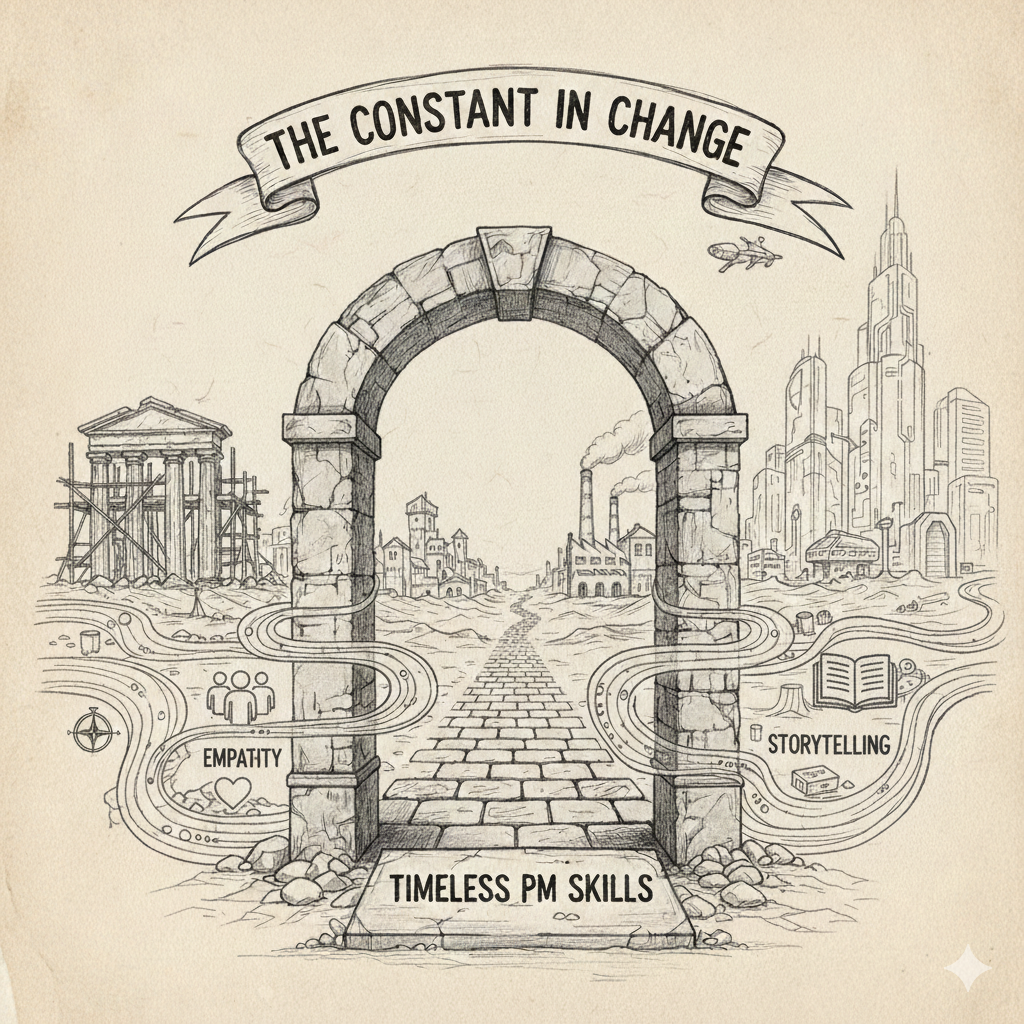
In an era where AI enables unprecedented complexity, the PM’s most valuable skill might be the oldest one: simplicity is the hallmark of truth, but complexity sells better. Knowing which path to choose defines great product leadership.
As a PM, the current times are challenging. PMs take pride in problem-solving and bringing clarity of thought to the table, balancing data-driven insights with judgment calls. After the ChatGPT moment of 2023, things have changed. Everyone can perform the above-mentioned tasks of the PM, just by being better at writing prompts.
So, this piece is a compilation not of the changes and realignment with regards to the PM role with the adoption of AI and vibe coding, but rather, this is a callout to what will stay the same for PMs. Like Morgan Housel puts it, there will be certain aspects that will remain constant.
Understanding Human Nature:
There is a secret to human nature which we can correlate and understand better than any machine or AI system. These tools can help us understand feedback, traverse volumes of conversations, or even analyze the clicks. However, with all of these advancements, the technology can only measure the “what”. As Product Managers, we have far greater insight into the “why”. This understanding of the why is a great skillset which is people-centric. People will still respond to greed, fear, opportunity, exploitation, risk, and uncertainty in the same way they always have. They will continue to be influenced by tribal affiliations and social persuasion. The core skillset that PMs will continue to thrive upon is going to be the connection with humans. People are people and they will not change for the sake of technology or tools. Users’ behavior will remain constant.
The Stories You Tell:
AI can generate patterns, provide insights, and analyze structured or unstructured data much faster than PMs. Itis the stories that matter, and PMs are the ones who take various pointers, stitch the story together, and createmeaningful impact. PMs will continue to have more context, can create better narratives, and continue to thrivein an uncertain world where others are relying on average outcomes from LLMs to generate their stories. PMsunderstand emotions better than AI systems, so they are better suited to create the stories to tell and the storiesthat will sell. Nobody remembers data points the way they remember the stories around a product.Prepare for the Risks, Known and Unknown:
AI systems know everything and assume answers for all scenarios. However, reality is far different. PMs arewell-positioned to gauge risks, use judgment, and work with countermeasures to mitigate them. Humanjudgment remains of paramount importance in the day and age of advancing technology. PMs have far morecontext of the challenges and risks associated with the products and features, so their wisdom and judgment forrisk assessment will continue to be valuable long after these technologies become mainstream.Balancing Expectations vs Reality:
With the advent of AI techniques and tools, there is a blurring line when it comes to building, developing, andshipping products. People who have a higher degree of maturity with AI understand the shortcomings, whereasthose who have lesser knowledge believe that AI has limitless possibilities. PMs are uniquely suited to balanceexpectationsversusrealityofhowfastandhowaccuratelyoutcomescanbeachievedbysolelyrelyingonAIexpectations versus reality of how fast and how accurately outcomes can be achieved by solely relying on AI.PMs must excel at aligning the expectations with the larger ecosystem, be it internal or external to theorganization.
Keeping It Simple:
AI, coupled with the human tendency to sell complexity, will create a treacherous path for product builders andproduct leaders. One of the key skills for PMs is going to be around simplicity. Breaking down the complexityand iterating until things get simplifi ed for the users, the developers, and the business stakeholders. PMs need toapply fi rst-order thinking and apply reasoning in order to understand what is being built, why it is being built,and whether it is being built in a manner that the end users make the most of it. PMs need to think simply andkeep eliminating the useless. AI can thrive on complexity; however, great PMs will adapt to keeping it simple.Empathizing and Putting in Perspectives:
AI doesn’t know how people behave. What is the range of emotions that users can operate on? PMs have aperspective on this. PMs understand the difference in user behavior along with emotions, circumstances, andsituations. AI will chart out a linear path for getting the results; it is the PM who needs to stitch multiple linearpaths and create a web which can lead multiple personalities and user types to get to the desired results. PMswill thrive in adding perspectives around personas, journeys, and emotions as a plethora of users get together touse their products.As a Product Manager, I do understand that change is rapid and for the good. The advancements in technology can lead to nervousness and anxiety of falling behind. I just want PMs to remember: they are not falling behind; rather, they are adjusting to the various tools and technologies available. You might not know all, but you will need to know some. Do your homework and keep upskilling, as AI will be an enabler that helps PMs do more in less time. The key differentiator is to keep in mind that some things will remain constant. Product Management is changing and evolving across the industry as different things are being done differently. The key is to stick toa plan, learn, and amidst all the changes, remember that some PM skills will be the same as ever.